
Regenerative leadership in practice: recovery is a working rhythm, not a perk
No football manager would plan a season with a match every day and zero recovery. But that’s exactly what most knowledge workers’ calendars look like. Recovery isn’t a perk you earn. It’s a working rhythm that has to be designed. And that’s where regenerative leadership stops being a word and becomes something in the calendar.
Recovery is a factor of production
In sport it’s obvious: muscles don’t grow under load, they grow in the rest afterwards. Training without recovery isn’t ambition. It’s overtraining, and it ends in injury. In knowledge work, the brain is the means of production, and it follows the same physiology: concentration, creativity and judgement are resources that get used up under load and rebuilt during breaks.
The difference is just that an overloaded shoulder tells you straight away, while an overloaded brain tells you slowly and quietly: quality drops, the creative solutions don’t come, and the short fuse gets shorter. No torn muscle, no sick note, just a team that gradually delivers worse and feels worse. That’s why regenerative leadership treats recovery as part of the work, not as a reward after it.
The calendar speaks its own language
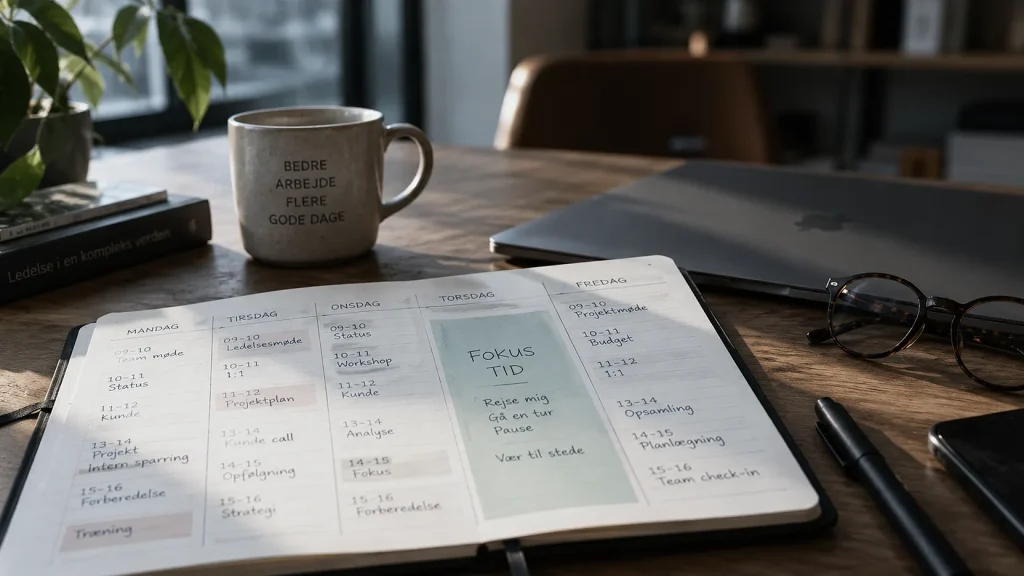
Pick any ordinary week in the calendars across your organisation. Meetings back to back, lunch eaten in front of the screen, and focused work pushed out to the margins, early morning and late evening. Microsoft’s research among 31,000 respondents shows that 68% don’t have enough uninterrupted focus time during the working day. When the day is eaten up by meetings, the evening becomes working time, and then there’s no such thing as recovery any more. There’s only borrowed energy, with interest.
It isn’t a willpower problem for the individual. It’s a design problem in the calendar, and design is a leadership task. We’ve gathered the steps for cutting the number of meetings in Meeting overload: how to get your focus time back.
Three rhythms to design
The daily rhythm
Make 25 and 50 minutes the meeting standard, so there’s breathing space between meetings: five or ten minutes to get up, fetch a coffee and land before the next conversation starts. Protect the lunch break as a break, not as a meeting slot with food. And avoid back-to-back afternoons: three video meetings in a row produce decisions nobody can remember the next day.
The weekly rhythm
Shared meeting-free blocks, for example two mornings a week, protect focus time for everyone at once. It works precisely because it’s shared: nobody has to stand up for their own focus time alone, and nobody books a meeting into them. It’s a good idea to place the blocks so they can also be used for deep work from home. That’s what days at home are best for.
The yearly rhythm
Peaks are fine: deadlines, go-lives and busy seasons are part of it. The regenerative question is what happens afterwards. After a go-live: a week with a lighter meeting cadence and room to tidy up, not a new sprint on Monday morning. Teams that get to recover after a peak come back stronger. Teams that don’t get it learn to ration their energy all year round.
Start by measuring, not by opinions
Discussions about meeting culture quickly turn into battles of opinion. Short-circuit them with data: take two weeks of calendar for a few typical employees and count meeting hours, uninterrupted focus blocks of more than 90 minutes, and breaks between meetings. The figures usually surprise people, management included. And they make the conversation concrete: “We need a better meeting culture” is an opinion; “our project managers have on average 40 minutes of uninterrupted focus time a day” is a problem you can act on. Measure again after three months: recovery is a rhythm, and rhythms can be read in the calendar.
Remember micro-recovery
The rhythms are management’s responsibility, but there’s also micro-recovery that each person can build in: getting up between meetings instead of clicking straight on to the next one, doing walk-and-talks for meetings that don’t need a screen, batching notification checks into fixed windows instead of letting them trickle in all day. Small daily habits, with a big effect. The catch is that micro-recovery only survives in a culture that recognises it: if going for a walk at 2 pm needs an excuse, nobody does it.
The leader sets the rhythm
Here’s the uncomfortable part: your behaviour is the policy. If you send emails on a Sunday evening, you’ve just cancelled the team’s day off, whatever the staff handbook says. If you race through lunch yourself and sit in meetings for nine hours straight, that becomes the norm. Visible recovery is a leadership task: schedule your evening emails to send later, block out your own focus time, and say so out loud when you take time off.
And make the agreements shared: when a reply is expected, which channels are urgent, what can wait until tomorrow. That’s what we mean by digital working habits, and it’s the part of looking after wellbeing that actually changes the working day. It’s also where our talk on wellbeing in the hybrid workplace starts.
“Recovery isn’t a break from work. It’s part of the work.”
If you want the whole framework in place, start with the guide What is regenerative leadership?, and see how your existing resilience work fits in with Hybrid resilience is regenerative leadership.
More on hybrid leadership
 Hybrid resilience is regenerative leadership, you just call it something elseHybrid resilience is about preparedness: the ability to anticipate, withstand and adapt when the world changes.…Read more →
 What is regenerative leadership? A down-to-earth guide without the incenseRegenerative leadership is leadership that rebuilds people’s energy and the organisation’s resources instead of using them…Read more →
 AI and hybrid leadership: the pitfalls, the potential and the culture that decides itBy now, AI has been rolled out in most organisations. Many have an AI policy that…Read more →