
Hybrid work research: how office time, working from home and social infrastructure shape culture
Hybrid work and the social infrastructure we forget to design
There’s been a lot of discussion about office time in recent years. How many days should we be in the office? What happens to culture and cohesion when we work more from home? And how do we take account of differences between employees, personality types and neurodiversity?
We got curious about what evidence actually lies behind all the opinions. So we set out to do some more thorough research into the area, and, very much a sign of the times, we used ChatGPT Deep Research as a thinking partner to go through research and reports across psychology, organisational research, hybrid work and neurodiversity.
Not just to find a simple answer, but to test what real evidence there actually is in the field, and where the simple answers don’t hold. Because the report doesn’t point clearly to either full-time office work or full-time working from home. If anything, it suggests that hybrid work can work really well, but that some of the organisation’s collective functions become more vulnerable if the work isn’t deliberately designed.
That applies especially to culture, onboarding, weak ties, informal learning, trust, social capital and collaboration across the organisation. In other words:
Hybrid work isn’t the problem.
Undesigned hybrid work is the problem.
An important methodological point from the report, though, is that research doesn’t measure everything equally well. Productivity, job satisfaction, turnover and communication patterns can be measured fairly clearly in the short and medium term. Culture, identity, loyalty and cohesion are harder, because they’re built up and broken down over longer periods. So we should be careful about very firm conclusions on culture. But at the same time we shouldn’t ignore the mechanisms the research can actually see: weaker networks, fewer new relationships, less informal learning, a greater risk of isolation and more silos.
If you’re curious to read the report and the prompt we used along the way, we share a link at the end of the article.
The debate often starts in the wrong place
Much of the debate about hybrid work quickly gets reduced to a question of how many days. Two days at home. Three days in the office. Full flexibility. Required attendance. But that’s often the wrong place to start.
One of the report’s central conclusions is precisely that the question of hybrid work shouldn’t start with location, but with function. The more interesting question isn’t just where the work happens, but which functions the way of working needs to support.
Individual focused work needs something different from innovation, and in fact we don’t all agree on whether creativity and innovation need the same thing either. Onboarding needs something different from writing reports. Collaboration across the organisation needs something different from a well-defined specialist task. And culture doesn’t simply arise in the same way in distributed work as it did when more of us automatically shared the same physical workday.
That absolutely doesn’t mean hybrid work is bad. On the contrary, the report shows there’s solid evidence that moderate hybrid work can bring gains in wellbeing, autonomy, job satisfaction and retention. Nicholas Bloom and colleagues’ randomised study at Trip.com is a good example. It found that a model with two days working from home a week improved job satisfaction and reduced staff turnover markedly, without performance or promotions suffering.
But the report also brings together research suggesting that more distributed work can weaken some of the things organisations rarely measure as precisely: weak ties, spontaneous knowledge sharing, informal learning, onboarding and relationships across the organisation.
So the report’s balanced reading isn’t that working from home is good or bad in itself. What seems to matter is the combination of autonomy and being anchored, socially and in the work. Hybrid work can strengthen wellbeing when it brings more autonomy and less commuting, but the gain can be eaten up if contact with the leader, colleagues, coordination and a shared direction gets too thin.
That’s exactly why hybrid work needs more deliberate leadership, not less.
Social needs aren’t the same as social uniformity
That people need relationships and a sense of belonging is hardly controversial. So what’s interesting in the hybrid debate isn’t the observation itself, but the consequence. The report suggests that as work becomes more distributed, some of the mechanisms that used to maintain relationships almost without our noticing disappear.
The short conversation after a meeting, or the quick exchange of ideas at the desk. The new employee who overhears how an experienced colleague handles a customer. The informal check-in where you quickly test an idea. Or all the small signals we pick up without realising about what actually matters in the organisation.
None of that is just socialising. It’s part of the organisation’s social infrastructure.
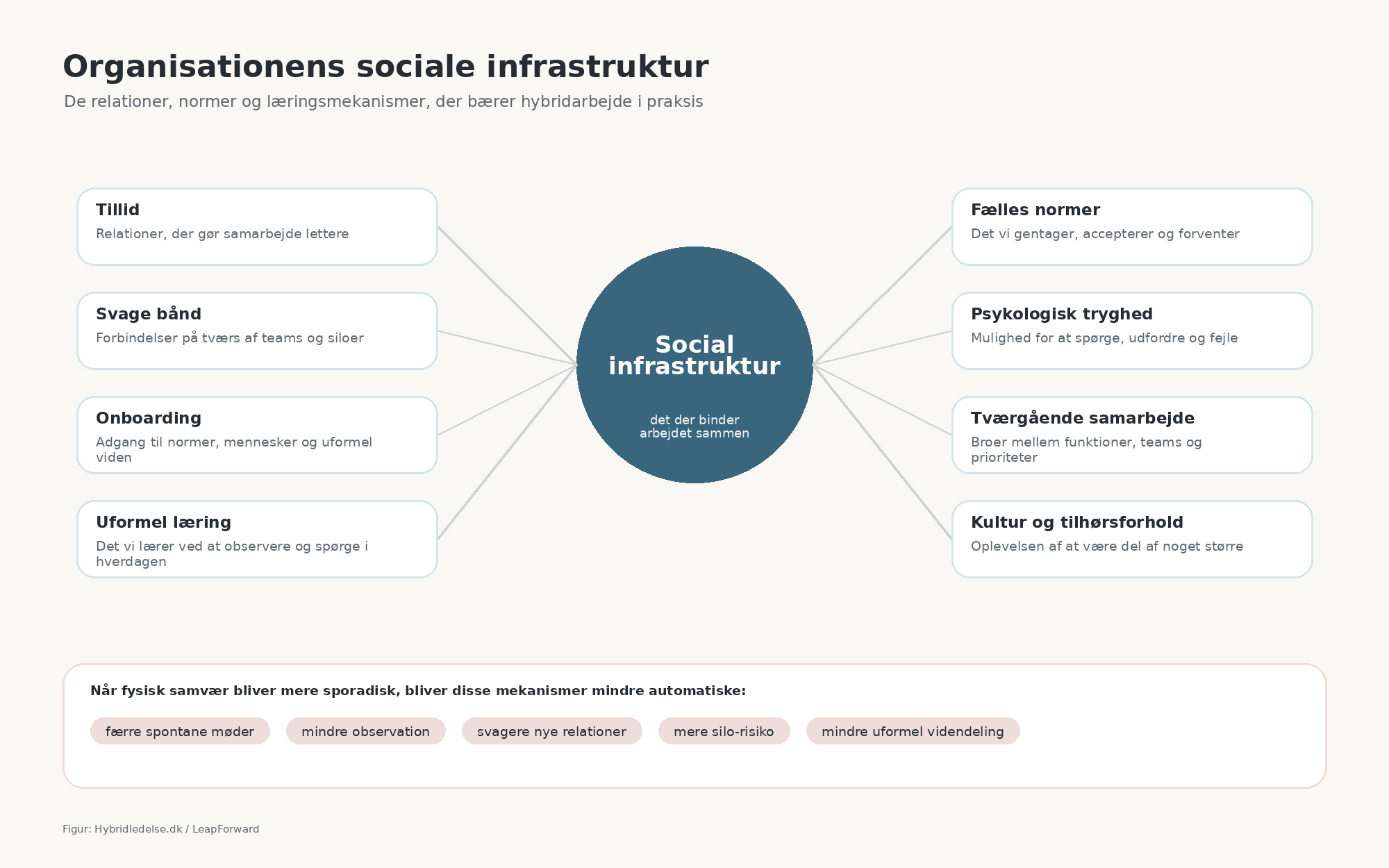
An organisation’s social infrastructure is made up of the relationships, norms and learning mechanisms that make collaboration, culture and cohesion work in practice.
When the physical workday becomes less shared, these things don’t necessarily happen by themselves. Some of them can be replaced digitally, others can’t. And some simply need a completely different level of awareness if they’re going to survive in a hybrid way of working.
This is where we think many organisations underestimate the task. They’ve designed the policy for working from home, but not necessarily the social infrastructure that has to make hybrid work work.
The report also suggests that this becomes even more important because employees don’t have the same needs. Introverts and extroverts can’t be reduced to “working from home” versus “working in the office”. If anything, the research suggests we need to distinguish between social connection, social energy, the need for recovery and preferences about working conditions.
An introverted employee can have a strong need for professional community and trust, but at the same time need quiet and fewer interruptions. An extroverted employee can thrive on lots of relationships, but still become ineffective in an office environment where the day is broken up by constant disruptions.
And if we bring neurodiversity into the picture, the point becomes even clearer. The report stresses that neurodivergent employees shouldn’t be portrayed as less social, but that their needs are often about something more specific: sensory load, structure, predictability, social energy and access to the right forms of collaboration.
For some neurodivergent employees, working from home can be a significant advantage, because it reduces sensory load, noise, interruptions and social exhaustion. For others, working from home can mean less structure, weaker ties to colleagues and less access to informal learning.
So the point isn’t that particular groups should always work from home or always come in. The point is that one-size-fits-all is rarely a good answer.
An important practical point from the report is that we need to differentiate without individualising everything. Employees have different needs, but the solution isn’t necessarily for everyone to have their own completely private arrangement. The strong hybrid workplace combines shared, coordinated ways of working with legitimate flexibility for people, roles and situations where the needs really are different.
Strong hybrid leadership has to be able to combine shared ways of working with intelligent flexibility. Not everyone doing their own thing. Not rigid uniformity. But a design for work where both community and difference are taken seriously.
Culture becomes more vulnerable when it becomes less automatic
The area we personally find most interesting is culture. Culture is often described as something mainly about soft values. But culture also lives in repeated everyday actions: how we collaborate, how much responsibility we take for the company, the customers and each other. How we share knowledge, handle mistakes, and how good we are at bringing new people into the culture we’ve all created together.
The report suggests that culture doesn’t necessarily disappear in hybrid organisations, but that it becomes less automatic. When people see each other less spontaneously, some of this becomes less visible. Not impossible, but less of a given.
And if we’re completely honest, culture before working from home perhaps wasn’t something we’d been all that deliberate about creating, but more something that just grew over time. At a distance, we have to be more intentional about the culture we want to create together.
Research from Microsoft, among others, has shown that working fully away from the office during the pandemic made collaboration networks more siloed and more static. There were fewer new connections across the organisation, and existing weak ties faded. That matters, because weak ties are often the ones that bring new ideas, alternative perspectives and understanding across the organisation.
It’s an important point from the report: in hybrid work, the strong ties within the immediate team can easily hold up, especially if the team already works well. But the weak ties across the organisation, the ones that hold it together as a whole, need more attention.
So does onboarding. The report stresses that new employees don’t only learn through induction programmes, system access and formal meetings. They also learn through observation, small conversations, informal questions and repeated social signals.
And who hasn’t been new at the office and been lucky enough to be invited to lunch by the colleague at the next desk? Not to mention all the regular meetings you don’t automatically get invited to, but where it’s often the colleagues around you who suddenly realise you weren’t on the list.
When we’re at a distance and there are fewer of those mechanisms, onboarding has to be designed more deliberately.
That’s one of the most important implications for leadership in the report. Not because everyone has to go back to the office every day, but because culture, learning and cohesion mustn’t be left to chance.
The office needs a clearer function
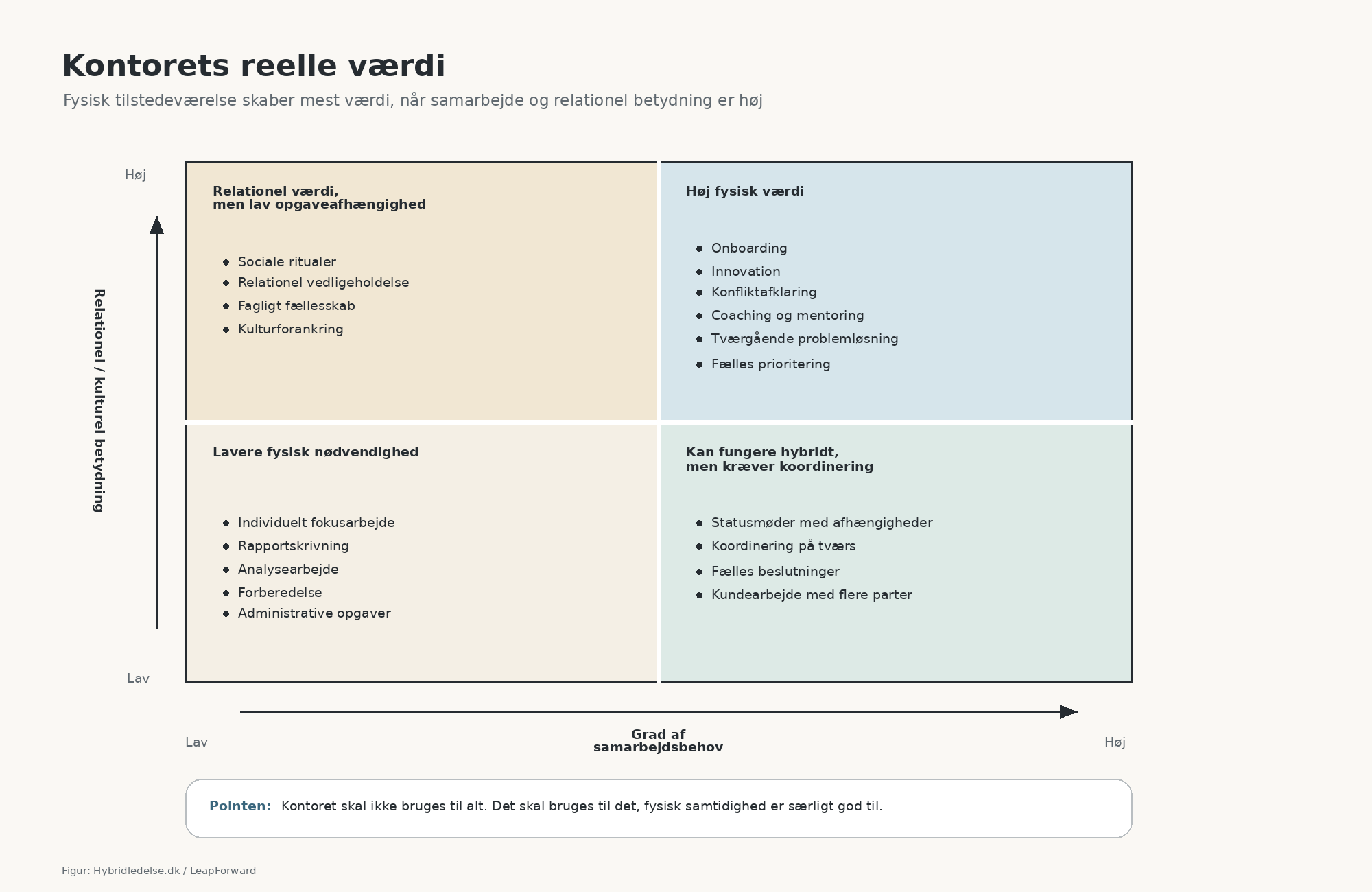
If the office is to play a strong role in a hybrid workplace, it shouldn’t mainly be understood as a place where you sit at a screen. The report concludes, rather, that the office’s value lies in getting people in the same place at the same time.
When the right people are present at the same time, it often becomes easier to coordinate, build trust, solve unclear problems, give feedback, onboard, share knowledge and maintain relationships. Without that overlap, office days easily become symbolic.
The report also highlights research on coattendance, meaning the importance of being physically present at the same time as the people you actually work with. The point here isn’t just that “the office works”, but that the office works better when attendance is coordinated. That supports the idea of shared anchor days rather than random individual self-scheduling.
This is also where many return-to-office initiatives miss the mark. If employees are asked to come in but end up sitting alone in online meetings all day, the office doesn’t feel meaningful. Then it feels like control dressed up as culture. And office time that simply wasn’t worth the commute.
So the question shouldn’t only be how many days people should be in the office. It should just as much be: what should the time in person be used for? Who needs to be there at the same time? Which tasks need people to be physically together? Which relationships need maintaining? How do we use the office for learning, innovation and a shared direction? And how do we make sure office days don’t just become ordinary working days with a commute added?
That’s a different and far more constructive conversation.
And it’s closer to what the report actually suggests: that physical presence shouldn’t be symbolic, but functional. The office shouldn’t be used for everything. It should be used for what being together at the same time is especially good at.
Is there a right number of office days?
There’s no strong evidence that every organisation should choose exactly two, three or four office days a week. But there are some patterns.
The report suggests that moderate hybrid work seems to work well in many settings, especially in knowledge work. Two days working from home a week were tested with good results in the Trip.com study. Other studies also suggest that the gains from flexibility are often greatest when working from home is combined with regular physical presence.
Three days in the office and two at home has become a common pattern in many knowledge workplaces. But the report’s point is important: common isn’t the same as optimal. It can be a sensible practical compromise, but not a universal rule.
But the report is also clear that the frequency should depend on the work. A team with high interdependence, many new employees, complex customer work or a strong need for innovation probably needs more coordinated time in person. A mature team with strong relationships, clear tasks and a high degree of individual expert work can probably manage with less physical presence.
That’s why it isn’t enough to ask how many days are right. You should look at how much the team depends on itself and on the teams it works with. How strong the relationships already are. How often you onboard new people, and what you need to do differently when you do.
This is where hybrid work becomes a leadership task and not just an HR policy. And it’s where it makes the most sense of all to involve employees in the organisational learning process that leads to a shared manifesto for the hybrid rhythm and ways of working.
From policy to practice
By now, many organisations have a hybrid policy. But a policy isn’t the same as practice.
One of the report’s practical conclusions is that a strong hybrid workplace takes more than a rule about the number of days. It takes clear team rhythms, clear expectations, a good meeting culture, strong onboarding, shared anchor days, social upkeep and deliberate use of the office.
It also takes leaders who dare to have the conversation about what flexibility means in practice. Flexibility doesn’t necessarily mean everyone always chooses individually. If everyone chooses their office days without coordination, you can end up with the worst of both worlds: people travel in without meeting the colleagues they were supposed to work with, and get neither the flexibility nor the relational gain of being together in person.
So flexibility has to be balanced with shared rhythms.
For us, that’s a central point. The strong hybrid workplace isn’t the one where everything is free, nor the one where everything is controlled centrally. It’s the one where the organisation has designed some good shared ways of working, and where teams are free to adapt them wisely to their work.
The report also points to another risk that often gets less attention: fairness and visibility. When employees make very different choices, an informal in-group can form around those who are physically present more often. That can affect access to projects, feedback, airtime, informal information and ultimately career opportunities. So organisations shouldn’t only measure how many people come in, but also keep an eye on whether hybrid work is creating hidden proximity bias.
Our conclusion
Having gone through the research, we’re not left with an argument for full-time office work. Nor are we left with an argument for full-time working from home.
We’re left with a more nuanced conclusion, which is also the report’s central message: hybrid work can bring big gains for wellbeing, autonomy and retention. People have real social needs, but they show up differently from person to person. Personality and neurodiversity make one-size-fits-all problematic. And organisations risk weakening culture, onboarding, weak ties, fairness and cohesion if hybrid work is left to individual chance.
So the next phase of hybrid leadership shouldn’t be about winning the argument over home or office. It should be about designing the social infrastructure better.
How do we meet? Why do we meet? What do we use the office for? How do new employees learn the culture? How do we maintain relationships across the organisation? How do we create flexibility without losing community? How do we make sure hybrid work doesn’t create an A team and a B team? And how do we make sure hybrid work doesn’t become either control or chance?
In our view, that’s the most important task in hybrid leadership right now.
Not more control, and not more drift.
But more deliberate design of the way people work, learn and stick together.
Click here to download the report and prompt (in Danish)
Contact us for a conversation about the hybrid workplace
You can download the report without any fuss, but we’d really like to hear from you if you need more inspiration to strengthen hybrid work, culture and leading at a distance.
More on hybrid leadership
 Hybrid resilience is regenerative leadership, you just call it something elseHybrid resilience is about preparedness: the ability to anticipate, withstand and adapt when the world changes.…Read more →
 What is regenerative leadership? A down-to-earth guide without the incenseRegenerative leadership is leadership that rebuilds people’s energy and the organisation’s resources instead of using them…Read more →
 AI and hybrid leadership: the pitfalls, the potential and the culture that decides itBy now, AI has been rolled out in most organisations. Many have an AI policy that…Read more →